Flutter vs React Native in 2026: Which Should You Choose? / Jul 5, 2026

Flutter and React Native are still the two frameworks most teams weigh when they want one codebase to run on both iOS and Android. Going into 2026 they are both mature and production ready, so the real question is not which is better in general. It is which one fits your team and your product.
The short answer
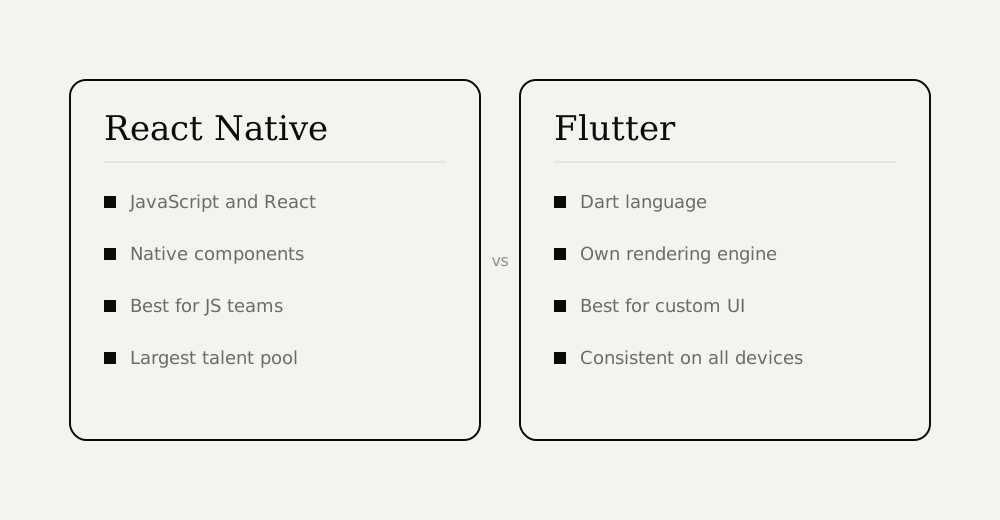
- Choose React Native if your team already writes JavaScript or React, or you want to share logic with a web app.
- Choose Flutter if you want pixel perfect, highly custom interfaces and identical rendering on every device.
- Choose native only when you need the absolute maximum performance or the deepest platform integration, and you can afford two separate builds.
Performance
Flutter compiles Dart to native code and draws the interface with its own rendering engine, which gives very consistent animation and layout across devices. React Native runs your JavaScript alongside native components, and its newer architecture has closed most of the old performance gap. For the vast majority of apps, forms, feeds, commerce, dashboards, both are more than fast enough. The difference only shows up at the extremes, like heavy real time graphics.
Cost and hiring
A single shared codebase is the main reason teams pick either one, because it can cut the budget substantially compared with maintaining two native apps. On hiring, React Native has the edge for now, since the JavaScript talent pool is enormous. Flutter needs Dart, which is quick to learn but less common, so you may spend a little longer finding specialists.
How to decide
Ask three questions. What does your team already know? How custom is the design? Do you need to reuse code on the web? If the answers point at JavaScript, shared web logic, and standard interface patterns, React Native is the safer bet. If they point at a bespoke, brand heavy interface with lots of custom motion, Flutter will feel better.
Whatever you pick, you are choosing a healthy, well supported framework. The worst outcome is not picking the wrong one. It is stalling on the decision instead of shipping.
Frequently asked questions
- Is Flutter better than React Native in 2026?
- Neither is better in the abstract. Flutter wins for custom, design heavy interfaces and consistent rendering across platforms. React Native wins for teams that already know JavaScript and want to share code with a web app.
- Which is cheaper to build with?
- Both are close. A typical cross platform MVP costs far less than building separate native iOS and Android apps, often saving between a third and a half of the budget for the same scope.
- Which is easier to learn?
- If you come from web development, React Native is easier because it uses JavaScript and React. If you are new to both, Flutter's widget model and tooling are very approachable once you learn some Dart.